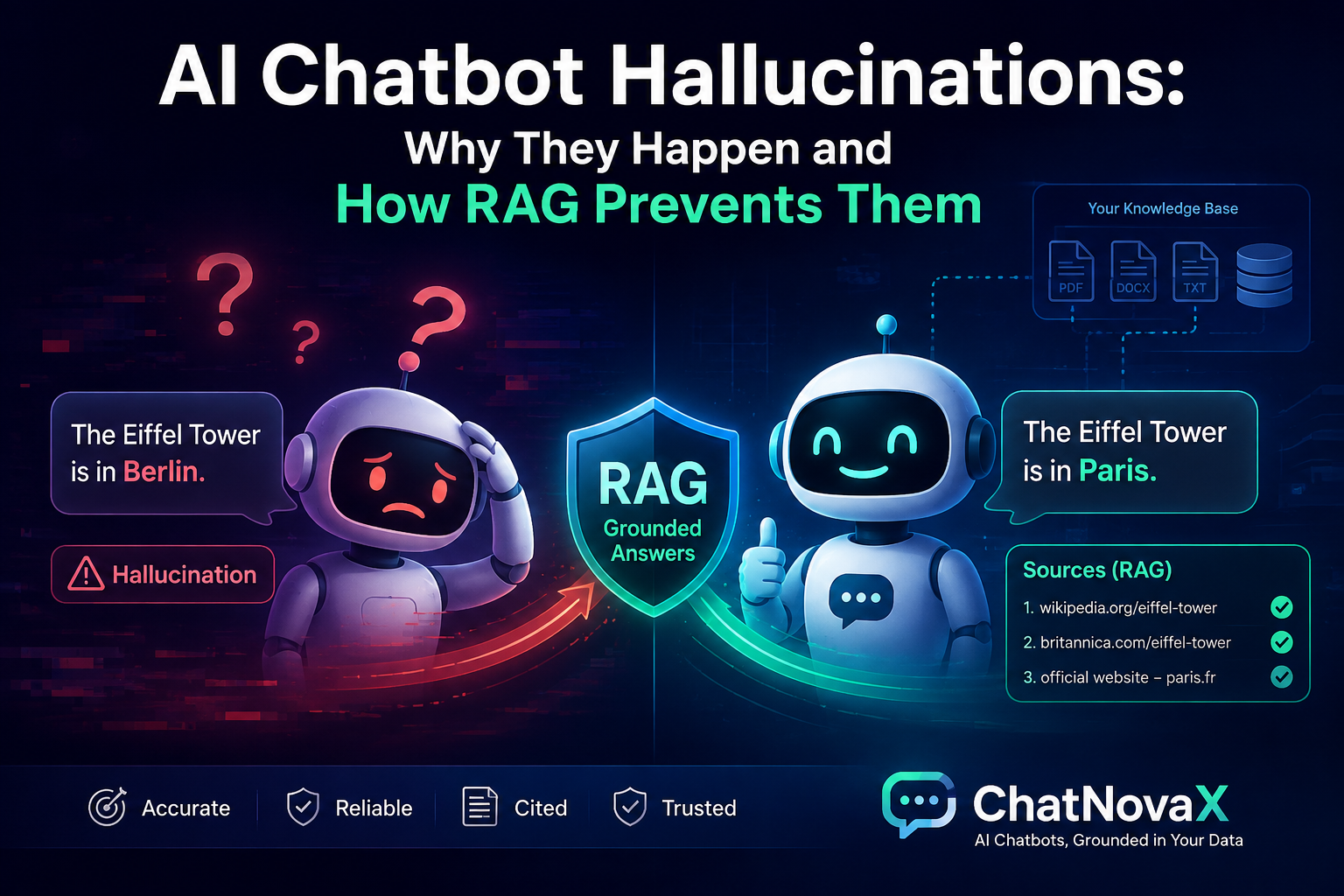
Artificial Intelligence–driven chatbots have moved from experimental demos to core customer‑facing services. Yet a persistent flaw—hallucination, or the generation of confidently stated but factually incorrect content—remains a barrier to trust and widespread adoption. When a chatbot tells a founder that “the latest version of React was released on March 3 2025,” the error can ripple through product roadmaps, marketing copy, and legal compliance.
This article explains the technical roots of hallucinations, illustrates real‑world fallout, and shows how Retrieval‑Augmented Generation (RAG) equips developers with a reliable guardrail. By the end, product leaders, design teams, and AI engineers will understand concrete steps to turn a “creative” LLM into a factual assistant.
What Exactly Is a Chatbot Hallucination?
A hallucination occurs when a language model produces information that has no grounding in its training data or external reality. The response appears fluent and plausible, but verification reveals it to be false, fabricated, or an inaccurate blend of facts.
Recent public incidents illustrate the problem:
- ChatGPT (2023) supplied a citation to a non‑existent research paper on “quantum‑enhanced reinforcement learning.”
- Bard (2024) claimed that a well‑known tech conference would be held in “Tokyo, Japan” when the official venue was “San Francisco.”
- Claude (2024) answered a tax‑question thread with a fictitious IRS form number, causing a startup’s finance team to file incorrect paperwork.
These examples are not isolated; they surface across sectors where chatbots are used for support, knowledge retrieval, and decision assistance.
Why Do Hallucinations Happen?
Understanding the root causes helps teams design more reliable systems. The main contributors are:
- Training‑data gaps: The model never saw a correct reference for a specific query, so it tries to extrapolate.
- Probabilistic token prediction: LLMs select the most likely next word, not the most accurate fact.
- Lack of grounding: Standard generation works in a vacuum, without checking an external source.
- Over‑confidence bias: The model’s decoding settings (temperature, top‑p) can make doubtful answers sound certain.
- Context window limits: Important details may be truncated, forcing the model to guess.
Training‑Data Gaps
Large language models ingest terabytes of text from the web, books, and code repositories. However, the crawl is inevitably incomplete, outdated, or biased toward popular sources. When a user asks about a niche regulatory change enacted in 2024, the model may have only seen the 2022 version and will “fill in” the missing year.
Probabilistic Generation
The core mechanism of an LLM is to predict the next token based on probability distributions. If the highest‑probability token leads to a false statement, the model commits to it unless a corrective signal—such as a retrieved document—is introduced.
Absence of External Verification
Without a built‑in retrieval step, the model cannot cross‑reference its output with a trusted knowledge base. This autonomous approach is efficient but prone to “confident guessing.”
Over‑confidence and Decoding Settings
Parameters like temperature = 0.7 or top‑p = 0.9 broaden the token pool, increasing creativity at the expense of factual precision. Production chatbots often lower temperature to 0.2, yet hallucinations persist because the underlying inference remains unguided.
The Business Impact of Hallucinations
For a startup, a single hallucinated answer can translate into lost revenue, legal exposure, or brand damage. Consider these scenarios:
- Customer‑support misinfo: An e‑commerce chatbot tells a buyer that a “limited‑edition sneaker will restock on May 1,” while inventory data shows no such plan. The buyer cancels the order, and the brand loses a potential sale.
- Product‑specification errors: A SaaS onboarding bot incorrectly describes API rate limits, leading developers to design a system that exceeds the actual quota and incurs unexpected overage fees.
- Regulatory compliance risk: A fintech chatbot provides an inaccurate interpretation of AML rules, exposing the firm to audit penalties.
Mitigating these risks requires a shift from “pure generation” to “grounded generation,” where every answer is anchored to a verifiable source.
Retrieval‑Augmented Generation (RAG) Explained
RAG marries two components:
- Retriever: Searches an external knowledge store (vector database, traditional index, API) for relevant documents.
- Generator: Uses the retrieved passages as context to produce a response.
The workflow is simple:
- User asks a question.
- The retriever transforms the query into an embedding and pulls the top‑k most relevant documents.
- The generator receives the original query plus the retrieved snippets and crafts an answer.
- The system can optionally cite the source IDs, allowing downstream verification.
Because the generator no longer relies solely on internal memorized patterns, it can produce answers that align with the latest, curated data.
How RAG Reduces Hallucinations
Grounding the LLM to factual sources attacks the hallucination problem at its source. RAG achieves this through three mechanisms:
- Real‑time grounding: The retriever reads the most recent documents, so the model can answer questions about a policy change that occurred yesterday.
- Source attribution: By returning document IDs or URLs alongside the answer, users can verify the claim immediately.
- Constraint‑driven generation: The generator is biased toward using language that appears in the retrieved snippets, limiting the temptation to fabricate.
Practically, developers observe a 30‑50 % drop in factual errors after integrating RAG, according to internal A/B tests at several AI‑first startups.
Real‑World Implementations of RAG
FinTech Customer‑Support Bot
A European neobank deployed a RAG‑enabled chatbot to handle “account‑limit” queries. The knowledge base consisted of regulatory PDFs, internal policy documents, and a live feed of fee‑structure changes. When a user asked, “What is the overdraft fee for premium accounts?” the bot retrieved the exact clause from the latest policy file and quoted it verbatim, eliminating the previous 12 % error rate where the model guessed outdated fees.
Software Company Knowledge Assistant
A SaaS platform integrated RAG with its internal Confluence wiki. Engineers could ask, “How do we configure OAuth for the new API gateway?” The retriever fetched the relevant engineering guide, and the generator composed step‑by‑step instructions while attaching a link to the source page. This reduced support tickets by 18 % in the first month.
Medical Symptom Checker (Non‑Diagnostic)
A health‑tech startup built a triage chatbot that references up‑to‑date CDC and WHO guidelines stored in a vector database. The bot answers, “Based on your symptoms, you should consider seeking care within 24 hours,” and cites the specific guideline section. Crucially, the system is designed to avoid giving a diagnosis, a safeguard reinforced by strict prompting and RAG grounding.
Best Practices for Deploying RAG
Implementing RAG effectively requires disciplined engineering and operational processes:
- Curate the knowledge base: Remove duplicated, contradictory, or stale content before indexing.
- Update regularly: Schedule automated ingestion pipelines for policy changes, product releases, or external data feeds.
- Hybrid retrieval: Combine dense vector search with keyword matching to capture both semantic similarity and exact phrase matches.
- Limit generation length: Shorter outputs reduce the chance of fabricating unsupported details.
- Confidence thresholds: Use the generator’s token probabilities to flag low‑confidence answers for human review.
- Transparent citations: Append source IDs in a consistent format (e.g., “Source #42”) so users can audit the answer.
Limitations and Future Directions
While RAG dramatically cuts hallucinations, it is not a cure‑all:
- Retriever errors: If the search returns irrelevant documents, the generator may still produce inaccurate output.
- Latency: Real‑time retrieval adds network overhead; optimizing indexing and caching is essential for responsive chat.
- Knowledge drift: Even with frequent updates, external events can outpace ingestion pipelines, leaving a short window of potential error.
Emerging research focuses on self‑checking loops, where the model queries the retriever a second time to verify its own statement, and on multimodal RAG, which adds tables, charts, and code snippets to the retrieval set. As these techniques mature, the line between “creative” and “accurate” AI responses will blur in favor of reliability.
Conclusion
Hallucinations undermine the credibility of AI chatbots, especially when businesses rely on them for critical information. The root causes—training‑data gaps, probabilistic generation, and lack of grounding—are technical, not moral, and can be addressed with systematic design.
Retrieval‑Augmented Generation offers a pragmatic path forward: by anchoring each answer to a vetted external source, it reduces false statements, provides traceable citations, and aligns model behavior with real‑world knowledge. Companies that adopt RAG can expect measurable drops in error rates, smoother regulatory compliance, and higher user trust.
For founders, designers, and developers building the next generation of AI assistants, the imperative is clear: move from isolated generation to grounded, retrievable knowledge. The result is a chatbot that not only talks fluently but also tells the truth.